"Shouldn't all debts just be paid?" Find out the answer to this, as well as other key questions about the global debt crisis.
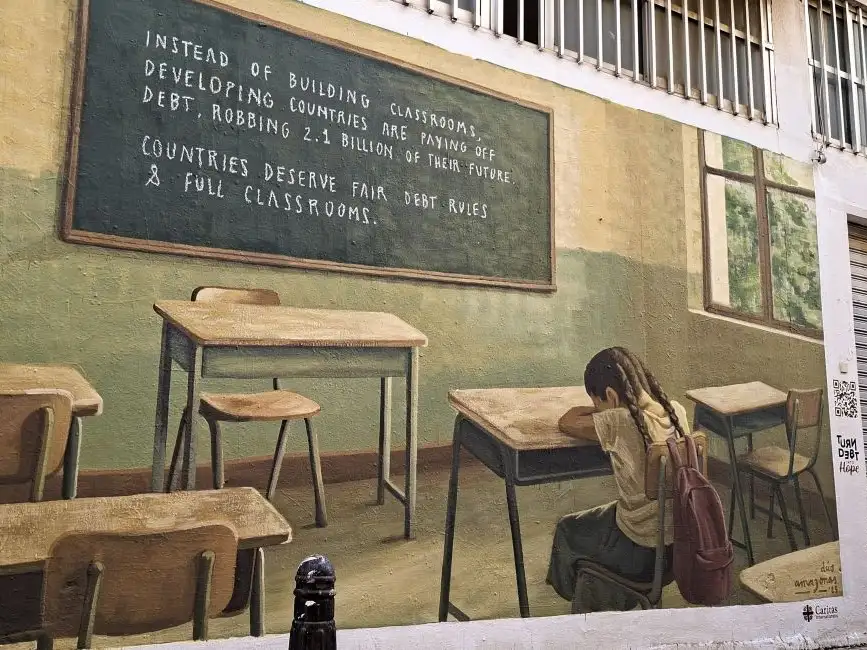
Many of the world’s poorest countries have been plunged into a debt crisis. Despite facing significant poverty burdens, countries are having to make huge payments on high-interest loans to wealthy banks, institutions and governments, leaving them unable to properly fund essential services. Often, the original debt has been repaid many times over but will never be cleared because the interest keeps on growing.
Low-income countries have been facing increasingly unsustainable debt since the 2008 financial crisis, when banks, hedge funds and traders ('private lenders') saw an opportunity to make vast sums of money by lending to them at high interest rates. Crises in the 2020s, including the pandemic, exposed the fragility of these debts, forcing countries to borrow further at extortionate rates. Now many countries are trapped in a spiral of debt that can't be cleared.
Furthermore, when a country requests debt cancellation because they are unable to meet payments, other governments, and multilateral institutions like the World Bank and IMF, work with that country to find a way forward. But private lenders have not taken on the same responsibility, often holding out for maximum profit. They insist on payments no matter the human cost.
Wesley Chibamba from Caritas Africa explains: “At the moment people are dying because they can’t access healthcare. Children cannot go to school. People are going hungry and children are sleeping on empty stomachs because the governments have debt obligations. Governments don’t have the capacity to respond to humanitarian crises, like floods or droughts – they don’t have the funds.”
As Archbishop Gabriele Giordano Caccia says, “The current debt crisis represents a profound failure of our global economic system…If a mother cannot access prenatal care because the government has cut healthcare spending to service debt, if children are sent home from their classroom when the teachers are not paid, and if communities cannot rebuild after disasters because the resources are diverted to foreign creditors, we must acknowledge that there has not just been a serious economic failure but a moral one.”
Primarily we need more ambitious action from decision-makers. We are calling for two specific things this year from the UK Government, and we need your support to make sure they hear this:
1. Pass a Debt Justice Law
Incredibly, almost 90% of debt contracts of the poorest countries are governed by English law due to the pivotal role of the City of London in the global financial sector. This makes the UK a ‘debt superpower’! And we are the citizens who can influence them. The UK oversees how these debts are enforced, and we want our government to pass legislation that would ensure fair and equal treatment for lenders so that countries’ debts are reduced in a more comprehensive way.
This would require wealthy banks to participate in debt relief fairly so they can’t make huge profits from countries in crisis, as they are currently doing.
2. Lead reform of the global debt system
In 2027 the UK will host the G20, a crucial gathering of the world’s most powerful economies. We want the UK to bring governments together to fix the global debt system, as they have the power to do, and guarantee fast, fair and effective debt relief for countries in crisis.
Yes it did. And we need to carry on. The global debt campaign in 2025, the Jubilee Year, was about building a case for urgent action. 35,000 CAFOD supporters signed our petition and over a thousand of you emailed your MP. We worked with others around the world, especially in the Caritas network, to push this issue into the spotlight. This global campaigning added a real sense of public mandate to the discussions on debt at global summits last year, including the G7, G20 and UN General Assembly, and increased pressure on politicians to act on this key issue.
We’ve seen a shift in how the debt crisis is viewed by the UK Government. Ministers and officials now speak openly about the need to tackle unsustainable debt. The Foreign Secretary, Yvette Cooper, in response to a question in the House of Commons that referenced CAFOD’s work on the debt crisis, said: “Countries should not be held back economically by unacceptable debt repayments that make them more fragile and end up in a vicious cycle.”
Similarly, we’ve seen a change in the openness of the government to explore solutions. Baroness Chapman, Minister for International Development and Africa, has said, “Some countries spend far more on debt repayment than they do on health and education and public services. That is not sustainable and we need a solution. Various options are available…”
This is all encouraging – but the government are yet to translate these words into action, so we are calling on them to do two key things this year. It’s not the same petition – it is updated with our asks in 2026. There are more details overleaf. We are very well placed to follow up on the progress we’ve made so far and push for more ambitious action, but we need to show public support. Every signature you collect will help us do this.

We are calling on the UK government to do two urgent things in 2026 to address the global debt crisis:
Pass legislation to ensure private lenders can no longer make huge profits from countries struggling with unsustainable debts
Use the UK's presidency of the G20 in 2027 to fix the global debt system.
Often, low-income countries have repaid their original debts but they're paying them several times over because of sky-high interest. The current system isn't working. We believe that paying debts should not be put ahead of funding vital public services like health and education. Doing so means debt payments to lenders are being prioritised over life itself.
Private lenders lent to lower income countries at high interest rates – around 6-10% - at a time when they were lending to governments like the US and UK at 0-1%. They supposedly charged these high interest rates because of the risk of not being paid. Therefore, the lenders were always aware that defaulting might be a risk.
Over recent years we have had a succession of shocks – the Covid pandemic, rising food and energy prices, rising global interest rates, and climate disasters. The risk has materialised, and so private lenders must be made to take part in debt relief. Otherwise they will make mass profits, while people in the affected countries will suffer from declining public services and economic stagnation.
Existing structures are not providing solutions to corruption. Only under a more transparent and comprehensive global debt system can corruption be tackled. Developing a transparent global debt registry is one systemic change that would enable citizens to better hold borrowing governments to account.
History demonstrates that, overall, money gained from debt relief is not spent irresponsibly or illegitimately. Indeed, following the Jubilee 2000 campaign, in countries that had debts cancelled children completing primary school increased from 45 per cent to 66 per cent as the money saved on debt repayments went into public services.
More broadly, without global economic structures that enable low-income countries’ economic and political development – including the development of strong political institutions, economic growth, and investment in public services – tackling corruption is extremely difficult. Enabling long-term development by reforming global debt structures is therefore essential to global efforts to reduce corruption.
Not if we reform the system to stop the cycle of debt crises from happening. We need clear legislation and a permanent global debt mechanism to ensure that debts are agreed transparently and that there is a functional relief and restructuring framework.
This will incentivise lenders to be more responsible with their loans, taking greater care over whether they can be repaid. A transparent register of loans would also help hold governments and lenders to account, and so make problem debts less likely to arise.
Beyond this, we need to tackle other underlying causes of lower income countries being so dependent on debt in the first place, such as tax avoidance and evasion, unfair trade rules, and the climate emergency.
CAFOD has campaigned against unjust debt for a long time. After decades of debt justice activism in the Global South, the late 1990s saw the issue of debt become a mainstream issue with the Jubilee 2000 movement.
Between 2000-2015 the global Jubilee campaign won $130 billion of debt cancellation for 36 lower-income countries, which on average reduced their debt by three quarters. In countries that had debts cancelled, children completing primary school increased from 45% in the 1980s-90s to 66% by 2012 as the money governments saved went into public services.
However, the scheme did not prevent debt crises recurring. Despite efforts by the Jubilee 2000 campaign, no new regulations were introduced to make lenders more responsible or transparent. The same structural causes that led to the crisis remain in place. That is why we need action now.
The Bible gives us a model of money lending which is about accompanying the vulnerable in order to help them, rather than to make profits:
“If you lend money to my people, to the poor among you, you shall not deal with them as a creditor; you shall not exact interest from them.” (Exodus 22:25)
Pope Francis spoke repeatedly and clearly about this issue, calling for action in the Jubilee Year:
"I ask that affluent nations acknowledge the gravity of so many of their past decisions and determine to forgive the debts of countries that will never be able to repay them. More than a question of generosity, this is a matter of justice.”


Find out how you can campaign with CAFOD on issues such as the global food system, the climate emergency, cancelling debt and human rights.